
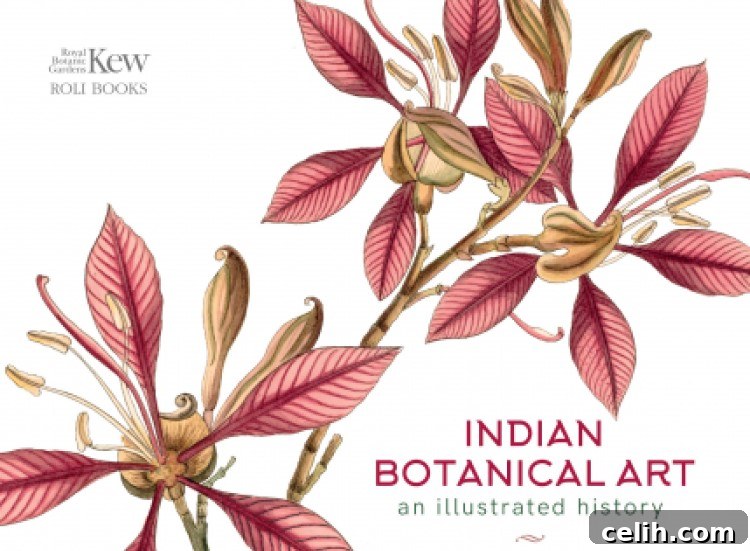
Indian Botanical Art: An Illustrated History – A Captivating Journey for Gardeners and Art Enthusiasts
Are you meticulously searching for truly unique gift ideas that are guaranteed to delight gardeners, ardent plant enthusiasts, or anyone with a deep appreciation for exquisite art and rich historical narratives? Your quest ends here. We warmly invite you to delve into Indian Botanical Art, an extraordinary illustrated history masterfully authored by the esteemed Martyn Rix and proudly brought to life by Kew Publishing. This volume promises to be more than just a book; it’s an immersive experience into a vibrant past.
In this comprehensive review, Sara Walker offers her insightful perspective on a volume that gracefully transcends the typical definition of a coffee table book. Offered at a recommended retail price (RRP) of £25 for its beautifully presented hardback edition, this treasure is conveniently available for direct purchase from the Kew Gardens online shop. Martyn Rix, a renowned botanist, horticulturist, and prolific author, brings decades of unparalleled expertise and passion to this project, ensuring a scholarly yet profoundly accessible exploration of this fascinating subject. Kew Publishing, celebrated globally for its unwavering dedication to botanical knowledge, scientific accuracy, and the production of stunning publications, demonstrates once again why it stands as an authoritative pillar in the world of natural history literature and botanical art.
The Irresistible Allure of a Coffee Table Masterpiece: Beyond the Cover
There exists an undeniable, magnetic charm to a truly well-crafted coffee table book – a substantial volume meticulously designed to serve as both an elegant aesthetic statement and an effortless gateway to discovery. Indian Botanical Art flawlessly embodies this ideal, elevating it to an art form in itself. From the very moment you lift it from its resting place, its impeccable presentation and the sheer abundance of its lavish illustrations immediately captivate the senses. This isn’t merely a book to be read from cover to cover; it’s an immersive experience to be savored, a magnificent visual feast that invites both casual, contemplative browsing and deep, scholarly dives into its rich content. The robust, high-quality hardback binding, the luxurious feel of the paper, and the vibrant, faithful reproduction of each intricate artwork all converge to create a premium tactile and visual experience, instantly cementing its status as a sophisticated, luxurious addition to any discerning home library or display collection.
As Sara Walker astutely observes, it is an “unusual volume,” and it precisely this distinctiveness that sets it apart from more conventional art books. Its specific, yet universally appealing, subject matter — the intricate beauty of Indian botanical illustration — ensures its uniqueness. The sheer visual impact, further enriched by an intriguing and compelling historical context, elevates it far beyond mere decorative object. Instead, it transforms into a profound conversation starter, elegantly signaling an owner’s cultivated interest in art, the natural world, and the fascinating tapestry of cultural history.
A Glimpse into History: The Fascinating Roots of Botanical Illustration in India
The enlightening foreword of Indian Botanical Art meticulously sets the stage for a remarkable historical journey, transporting readers with vivid detail back to the 18th century – an era profoundly marked by a burgeoning and insatiable European interest in the natural world. This period heralded an unprecedented surge in global exploration, meticulously driven by a complex interplay of burgeoning scientific curiosity, ambitious commercial ventures, and an overarching desire to systematically catalogue the world’s incredibly diverse flora and fauna. European travelers, particularly those operating under the auspices of the formidable East India Company and participating in various scientific expeditions, arrived on the shores of Asia with a keenly defined objective: to systematically document the vast, unexplored array of unknown plant species. Their primary focus was often directed towards species identified as having potential economic value, significant medicinal properties, or uniquely distinct botanical characteristics that could further European scientific understanding.
Astutely recognizing the invaluable depth of local knowledge and the exceptional artistic talent inherent within Indian communities, these European patrons initiated the commissioning of highly skilled Indian artists to undertake the intricate and demanding task of creating precise, scientifically accurate, and aesthetically detailed botanical drawings. These meticulously executed commissions were absolutely crucial for the then-nascent scientific classification systems and for fostering a deeper botanical understanding, long before the advent of modern photographic technologies. The artists involved were far from mere copyists; they masterfully employed sophisticated techniques, seamlessly blending traditional Indian miniature painting styles with the rigorous demands of European scientific methodologies. Their meticulous work captured every minute detail – from the delicate morphology of petals and the intricate venation patterns of leaves to complex root systems and nascent seed pods – often depicting plants across various stages of growth, a hallmark characteristic of exemplary scientific botanical illustration.
What initially began as a purely scientific and utilitarian endeavor gradually underwent a profound evolution. As the intrinsic beauty and undeniable accuracy of these exquisite illustrations became increasingly apparent and widely recognized, they transcended their primary scientific purpose. They progressively gained widespread recognition and profound appreciation as a distinct, fashionable, and highly valued art form in their own right. This fascinating transition vividly highlights a unique cultural fusion, where deeply rooted Indian artistic traditions met the uncompromising rigor of Western scientific inquiry, giving birth to a truly unique genre of art that is simultaneously aesthetically stunning, scientifically precise, and historically significant, reflecting a powerful cross-cultural dialogue.
The Artworks: A Kaleidoscope of India’s Diverse and Exotic Flora
One of the most profoundly captivating and immediately arresting aspects of Indian Botanical Art is its incredibly generous and lavish collection of gorgeous, full-colour plate reproductions. The pages are quite literally “stuffed” with these exquisite drawings, each serving as an eloquent testament to the unparalleled skill and dedication of the original artists and to the breathtaking vibrancy and unparalleled diversity of India’s immense plant kingdom. For those who possess a familiarity with traditional botanical art, the stylistic approach will undoubtedly resonate: plants are consistently depicted with remarkable precision and an almost microscopic attention to detail, meticulously showcasing various pivotal growth stages. They frequently present leaves and flowers meticulously laid out, almost resembling a botanical diagram transformed into a captivating work of art, designed for both scientific study and aesthetic pleasure.
However, as the reviewer, Sara Walker, so aptly points out, there’s an utterly thrilling and delightfully “unfamiliar twist” to these stunning illustrations. Even for a seasoned, dedicated gardener with extensive experience, the vast majority of the depicted plants are likely to be entirely new and wondrous discoveries. This palpable sense of exoticism, discovery, and profound wonder is undoubtedly a significant and compelling part of the book’s broad appeal. Imagine the sheer delight of idly flipping through its sumptuously illustrated pages and unexpectedly encountering the peculiar, almost alien beauty of a vibrant spider flower, the robust and imposing grandeur of Himalayan Rhubarb, or the glossy, sophisticated allure of a rare lacquer plant. These are emphatically not the familiar, comforting roses or the aromatic lavender commonly found in a typical Western garden; they are unique species indigenous to the diverse landscapes of India, revealing a biodiversity that is both breathtakingly rich and profoundly varied.
The unparalleled detail captured within these reproductions allows the reader to deeply appreciate the intricate textures, the subtle, nuanced gradations of colour, and the delicate, often ethereal forms that Indian artists so masterfully captured with their brushes. Each individual plate is far more than just a mere image; it serves as a compelling window into an 18th-century botanical world, painstakingly recorded and presented with an artistic flair that elevates it far beyond simple scientific documentation. It is, in essence, a glorious celebration of nature’s endless and ingenious variations, meticulously rendered with both scientific precision and profound artistic passion.
Beyond the Petals: A Rich Tapestry of Stories, Context, and Cultural Exchange
While the sheer visual splendor of the plants themselves undeniably forms the beating heart of the book, Indian Botanical Art offers a far more expansive and enriching experience than just aesthetically pleasing pictures. Martyn Rix and Kew Publishing have meticulously ensured that the profound historical and cultural context surrounding these magnificent artworks is equally compelling and deeply informative. Readers will find themselves drawn into the intricate history of how these pivotal art pieces were originally commissioned, gaining a nuanced understanding of the diverse motivations of the European patrons and the inherent logistical challenges that accompanied such ambitious and groundbreaking projects. This carefully woven narrative thread provides an invaluable deeper appreciation for the unique historical and socio-cultural circumstances under which this distinct and beautiful art form flourished and evolved.
Furthermore, and crucially, the book sheds much-needed light on the often-anonymous or overlooked Indian artists themselves. It delves into their traditional training, their innovative artistic methods, and the remarkable fusion of indigenous techniques with the exacting demands of scientific illustration imposed by their European patrons. This specific focus on the human element behind the art offers invaluable insights into the complex cultural exchange and intellectual dialogue that profoundly defined this historical period, finally giving a much-deserved voice and recognition to the incredibly skilled individuals whose significant contributions have, for too long, remained largely under-recognized and uncelebrated. The thorough exploration of various artistic styles and methodological approaches employed across different geographical regions and historical periods within India adds yet another layer of academic rigor, artistic appreciation, and cultural understanding, making the book a truly comprehensive resource.
This thoughtfully designed multidisciplinary approach ensures that the book resonates and appeals on “a great many levels,” making it substantially more than just a fleeting visual indulgence. It firmly establishes itself as a vital resource for anyone seeking to understand the intricate interplay of scientific inquiry, artistic expression, and colonial influence in shaping our collective knowledge of the natural world and the enduring legacy of botanical illustration.
A Gift That Keeps on Giving: Unparalleled Appeal for Every Enthusiast
The universal and broad appeal of Indian Botanical Art stands as one of its most compelling and strongest selling points. As a reviewer, Sara Walker emphatically states she “would have been delighted to get this as a Christmas present,” a heartfelt sentiment that countless individuals will undoubtedly share. Its expansive appeal ensures it stands out as a stellar and thoughtful gift choice for an incredibly diverse range of individuals and interests:
- For Gardeners: It provides an exotic and captivating journey into unfamiliar flora, offering fresh inspiration and a profound historical perspective on the fascinating process of plant discovery. It’s an unparalleled opportunity to explore plants far removed from the familiar confines of temperate gardens, potentially sparking a vibrant new interest in tropical or subtropical species and their unique cultivation requirements.
- For Artists and Art Historians: The book serves as an exceptionally rich and detailed study in the specialized techniques of botanical illustration, exploring the intricate fusion of Eastern and Western artistic traditions, and charting the compelling evolution of a highly niche yet globally significant art form. It’s an excellent and indispensable reference for anyone deeply interested in drawing, painting, historical illustration, or the broader history of visual arts and cross-cultural artistic exchange.
- For Historians and Indophiles: Those with a keen interest in the history of India, the dynamics of colonial-era scientific expeditions, or the profound cultural exchanges that transpired between the East and West will discover an absolute treasure trove of meticulously researched information. The book offers a unique and illuminating lens through which to view 18th and 19th-century intellectual, scientific, and artistic interactions, providing deep insights into a pivotal historical epoch.
- For General Readers and Coffee Table Book Enthusiasts: Beyond its specific academic and niche appeals, it remains, at its heart, a simply breathtakingly beautiful and richly colorful volume to casually flick through. Its immense visual grandeur, combined with an accessible and engaging narrative, makes it absolutely perfect for casual enjoyment, guaranteed to spark curiosity and offer moments of quiet contemplation and aesthetic pleasure.
Ultimately, Indian Botanical Art is precisely the kind of profoundly rewarding book that continually offers new insights and delights its reader. Each and every time you choose to open its magnificently illustrated pages, whether for a quick, admiring glance at a stunning illustration or a deeper, more focused dive into its illuminating historical chapters, you are virtually bound to “learn something new.” It represents a captivating, harmonious blend of rigorous scientific accuracy, undeniable artistic beauty, and a profound historical narrative, collectively making it an indispensable addition to any discerning collection and an unforgettable, cherished gift for anyone who deeply cherishes the natural world and its timeless artistic interpretation.