
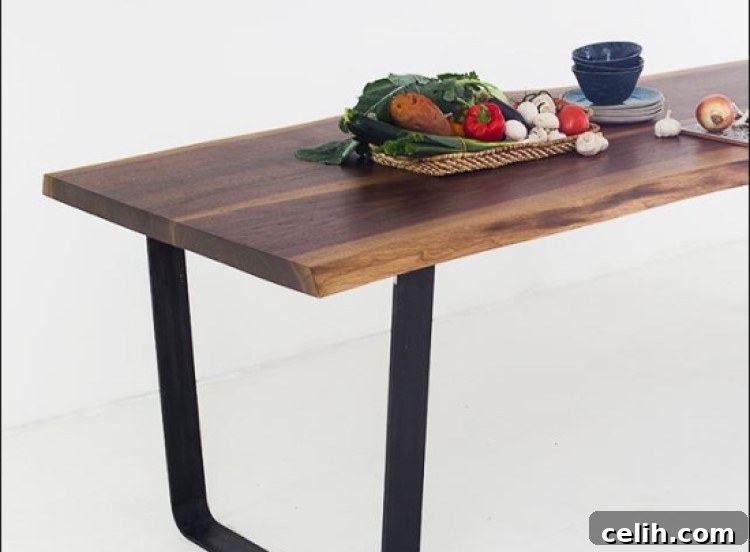
Hardman Design: Crafting Timeless Furniture with British-German Precision and Bauhaus Influence
In the dynamic realm of bespoke furniture, the narrative of Hardman Design stands out as a compelling testament to passion, innovative design, and meticulous craftsmanship. Founded by the visionary Liam Hardman, this distinguished company seamlessly integrates British design sensibilities with a deep appreciation for enduring German craftsmanship, culminating in an exquisite range of handmade furniture. Each piece, from sophisticated dining tables to luxurious beds, embodies a profound commitment to quality, functionality, and an aesthetic that transcends fleeting trends. This article delves into Liam’s inspiring journey, tracing his evolution from a burgeoning passion for electronic music in vibrant Berlin to the establishment of a thriving enterprise dedicated to producing extraordinary wooden furniture that resonates with discerning clients worldwide.
The Deep Roots of Craftsmanship: A Family Legacy Ignites a Spark
Liam Hardman’s inherent connection to the art of creating with his hands is deeply embedded in his family history, a lineage steeped in the trades of building and artisanal skill. “I come from a family of builders, and my dad trained as a stonemason and worked as a general builder for 40 years,” Liam fondly recounts. This early exposure to the disciplined art of stonemasonry and general construction provided an invaluable, albeit informal, education in the properties of materials, the principles of structural integrity, and the deep satisfaction derived from tangible creation. It was during a formative internship with his father at the tender age of sixteen that Liam experienced a profound revelation. “I discovered I loved working with my hands and creating something – it gave me a real feeling of fulfilment,” he explains. This pivotal moment sparked an enduring appreciation for craftsmanship, a seed that, despite being momentarily overshadowed by a different passion, would ultimately blossom into his life’s work. The fundamental lessons in form, durability, and the innate beauty of well-executed work, imparted by observing and participating in traditional building practices, laid a solid foundation for his future endeavors in bespoke furniture design.
From Sonic Architect to Furniture Innovator: The Berlin Chapter
Despite his early affinity for hands-on creation, Liam’s initial career trajectory was driven by a fervent passion for music. His academic journey led him to pursue a degree in sound design, a field that, perhaps surprisingly, shares many conceptual parallels with furniture design: a meticulous attention to detail, an inherent understanding of composition and structure, and the pursuit of harmonious balance. This academic pursuit provided an extraordinary gateway to Berlin, a city renowned globally as a pulsating epicentre for electronic music and home to the iconic Berlin Atonal festival. “I was lucky enough to have the chance to go out to Berlin, home to the famous Berlin Atonal festival, and still the place to be if you’re interested in electronic music,” Liam shares. This immersive experience in the German capital was more than just a professional opportunity; it was a profound cultural and creative awakening. He secured an internship as a sound technician, a role that immersed him in the intricate technicalities of audio production, spanning tasks from “checking the digital sound quality of Lana de Rey’s albums to digitising the entire back catalogue of a trash metal band!” Beyond the technical demands, Liam found himself utterly captivated by Berlin’s distinctive atmosphere and relentless energy, a powerful creative current that permeated every facet of life. This period, while dedicated to audio, undoubtedly refined his aesthetic discernment and his capacity to translate abstract concepts into tangible, impactful realities – skills that would later prove indispensable in his transition to the world of bespoke furniture design, demonstrating a remarkable cross-pollination of creative disciplines.
The Unforeseen Beginning: A Table, a Business, and a Bold Decision
The true genesis of Hardman Design emerged organically from the vibrant creative landscape of Berlin, stemming from a personal need that unexpectedly transformed into a viable business venture. “While living and working in Berlin, I made a table for my partner of the time,” Liam recounts. This initial utilitarian project quickly evolved beyond its functional purpose due to its inherent beauty and thoughtful design, resonating not only with Liam and his partner but also captivating others. “We liked the design so much we decided to try and sell it online,” he adds. To their genuine surprise, the table proved remarkably easy to sell, providing unequivocal validation for his nascent design instincts and burgeoning woodworking skills. This early success was more than just a sale; it was a powerful affirmation of a burgeoning market for modern, handcrafted furniture. What began as a one-off project soon blossomed into a compelling side venture, steadily gaining traction alongside his primary role as a sound technician. The year 2012 presented a critical juncture. As his sound design internship drew to a close, Liam faced a momentous decision: either accept a stable job offer within the music industry or fully commit to his rapidly growing furniture enterprise. Simultaneously, he was obligated to finalize the contract for a small workshop he had meticulously rented specifically for his woodworking projects. “That was quite a stressful time!” he reflects, underscoring the immense pressure accompanying such a pivotal career choice. Yet, his unwavering belief in the potential of Hardman Design fueled his resolve. The calculated risk yielded significant rewards; remarkably, by the end of May, a mere five months after committing to the workshop, his income from bespoke woodworking had already surpassed his earnings from his full-time job. This courageous leap of faith not only showcased Liam’s innate entrepreneurial spirit but also solidified his unwavering dedication to his newfound calling in handcrafted furniture.
The Art of Self-Taught Mastery: Precision, Persistence, and the Beauty of Wood
A truly remarkable facet of Liam’s journey into the world of furniture making is his largely self-taught mastery of woodworking. Far from being an impediment, this independent learning trajectory proved to be a profound source of personal satisfaction and a powerful testament to his unwavering determination. “I’m pretty much self-taught when it comes to woodwork, and I really enjoyed the whole process of training myself, finding the problems and teaching myself how to solve them,” he candidly states. This hands-on, iterative problem-solving approach allowed him to cultivate an exceptionally deep and intuitive understanding of timber as a material, exploring its vast possibilities and inherent challenges. His dedication to learning extended beyond mere trial and error; it involved actively seeking knowledge from every available avenue. “I got advice from everyone I could find and watched a lot of videos!” he openly admits, underscoring a pragmatic blend of traditional mentorship and modern self-education. This relentless pursuit of excellence underscored his commitment to achieving mastery in his craft. For Liam, wood is far more than a simple building material; it is a medium that offers unparalleled precision and a distinct, tactile warmth. “I’ve never really wanted to work with anything else but wood, I like the precision of it as a material,” he passionately emphasizes. This profound appreciation for wood’s intrinsic qualities – its unique grain, inherent strength, and versatile workability – is meticulously showcased in every Hardman Design piece. Here, precise joinery and exquisitely smooth finishes are employed to highlight and celebrate the natural, organic beauty of the timber. His diligently acquired, self-taught expertise directly translates into the impeccable quality, thoughtful construction, and enduring appeal of his bespoke wooden furniture, firmly establishing Hardman Design as a benchmark for contemporary craftsmanship in the industry.
Echoes of the Bauhaus: Where Form Meets Function in Modern Furniture
The foundational aesthetic philosophy that profoundly influences Hardman Design’s entire collection is deeply rooted in the iconic Bauhaus movement. This legendary German school of design, which emerged in the aftermath of the First World War, spearheaded a revolutionary shift in modern aesthetics by championing the harmonious unification of art, craft, and cutting-edge technology. Its core principle was to seamlessly merge aesthetics with functionality, thereby creating end products that were both minimalist in style and eminently practical in use. This profound philosophy resonates powerfully with the ethos of Hardman Design, where every piece of bespoke furniture is meticulously conceived not only to be visually striking but also supremely useful, exceptionally durable, and built to last. The distinctive hallmarks of Bauhaus – clean lines, purposeful geometric forms, and a deliberate absence of superfluous ornamentation – are elegantly integrated into Hardman Design’s bespoke wooden furniture. Their pieces characteristically exhibit a pared-down elegance, allowing the natural grain and the inherent quality of the sustainably sourced wood to command attention, much as Bauhaus designers advocated for the honest and transparent expression of materials. This direct influence explains the brand’s ability to effortlessly blend a modern sensibility with a timeless appeal, crafting furniture that feels distinctly contemporary yet possesses the enduring quality of classic design. It is precisely this thoughtful and deliberate balance of form and function that elevates Hardman Design beyond mere furniture creation, firmly positioning them as esteemed purveyors of lasting design statements for the sophisticated modern home, embodying true Bauhaus spirit.
Evolving Designs, Overcoming Challenges: The Spirit of Collaboration and Innovation
Hardman Design’s methodology for furniture creation has undergone significant evolution since its nascent beginnings, transitioning from a purely individualistic spark of inspiration to a highly collaborative and distinctly customer-centric process. “Designing at the beginning was a matter of inspiration and playing with ideas,” Liam muses, reminiscing about the early days of spontaneous creativity. Today, the dynamic is considerably more refined and interactive. “Now, the process is more customer-driven, and also a lot more collaborative with the other members of the team,” he elaborates. This significant shift underscores a profound commitment to not only addressing diverse client requirements but also strategically leveraging the collective expertise and innovative thinking of his skilled team. A pivotal milestone in the company’s growth trajectory was the successful completion of its “first big project,” a substantial dining table, by the end of that transformative summer. This accomplishment emphatically signaled their expanded capability to scale operations and undertake more ambitious and complex commissions. However, growth inherently brings its own set of challenges, a notable example being the evolution of their immensely popular MARTA dining table. Initially based on a specific, original design, burgeoning market demand necessitated a significant upscaling of its dimensions. This seemingly straightforward request presented a considerable engineering and aesthetic conundrum. “We had to redesign it to allow for the increased scale,” Liam reveals. The ingenious solution involved integrating a robust steel apron (frame), which allowed them to achieve the necessary structural integrity and enhanced stability without in any way compromising the table’s signature sleek, pared-down design. This innovative adaptation not only ingeniously resolved a complex technical challenge but also significantly enhanced the table’s durability and enduring appeal, firmly cementing its status as one of Hardman Design’s consistent best sellers. This iterative process of thoughtful design, confronting challenges head-on, and embracing continuous innovation remains a defining characteristic of the company’s unwavering dedication to both aesthetic excellence and unparalleled practical engineering in their bespoke furniture offerings.
Sustainable Growth, Global Reach, and a Forward-Thinking Vision
Eight years have passed since those transformative decisions, and Hardman Design has since flourished into a highly sophisticated operation, supported by a dedicated and exceptionally skilled team. “Now, eight years on, I have an excellent team working with me so that we can work on a larger scale without compromising on quality and craftsmanship,” Liam proudly articulates. This strategic expansion has empowered the company to efficiently fulfill larger orders and explore more intricate designs, all while rigorously upholding the artisanal quality that serves as the bedrock of their brand. A noteworthy development in recent years has been Liam’s return to the UK, a move that has strategically allowed him to dedicate more focus to the overarching creative and strategic direction of the company, effectively operating “behind the scenes.” This geographical transition has been remarkably seamless, largely due to Hardman Design’s intrinsic operational structure. As an online-only company that operates without a traditional physical showroom, remote work has always been a fundamental component of their business model. “Fortunately, as we’re an online-only company and have no showroom we all work remotely and we have excellent lines of communication in place, which is standing us in good stead in the current situation,” he observes, underscoring the remarkable resilience and inherent adaptability of their digital-first approach, a model particularly pertinent and advantageous in today’s rapidly evolving global landscape. This lean and flexible operational model not only offers considerable logistical flexibility but also uniquely positions Hardman Design to serve a broader, international clientele seeking premium, handmade furniture directly from the master craftsmen, embodying a modern approach to traditional artistry.
Looking ahead, Liam envisions a thoughtful and strategic expansion of Hardman Design’s diverse product offerings. “In the future, I’d like to expand the range a little to be able to offer more beds – they’re time-consuming to make so aren’t in everyone’s budget, but what we have so far is selling well,” he shares. This strategic move aims to cater to a steadily growing demand for premium, custom-made bedroom furniture, acknowledging the intricate craftsmanship and time investment required for each bespoke piece. Furthermore, he plans to “offer more seating to go with the tables,” thereby enriching the options available for customers who seek cohesive, elegantly coordinated, and functionally integrated living spaces. This balanced approach to growth meticulously blends artistic ambition with practical considerations of production efficiency and dynamic market demand. Hardman Design continues its journey of evolution, consistently pushing the boundaries of contemporary wooden furniture design while remaining steadfastly rooted in its core values of uncompromising quality, unwavering design integrity, and unparalleled artisanal excellence. As Liam profoundly concludes, “We’ll have to see what the future brings,” thereby inviting eager anticipation for the innovative and beautifully bespoke furniture pieces yet to emerge from their dedicated studios, promising continued innovation in handmade modern furniture.
To delve deeper into the exquisite range of handmade wooden furniture, explore their unique Bauhaus-inspired designs, or make an online purchase from Hardman Design, please visit their official website: www.hardmandesigns.com. Immerse yourself in the world of exceptional bespoke British-German craftsmanship and discover furniture that truly tells a story.
All images (c) 2020 Hardman Design.