
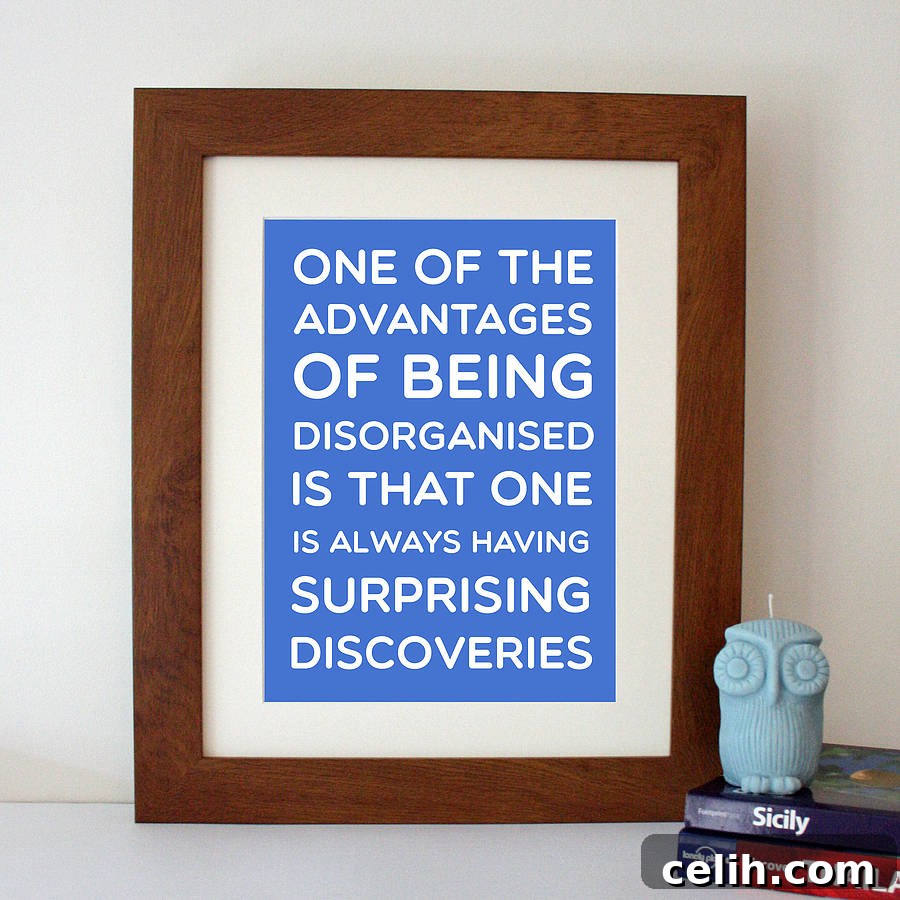
Embracing the Unexpected: How a Little Disorganization Can Lead to Surprising Discoveries, Inspired by Winnie the Pooh
Few literary characters encapsulate simple, profound wisdom quite like Winnie the Pooh. His gentle observations about life, friendship, and the world around him have charmed generations, offering insights that resonate far beyond the Hundred Acre Wood. While the image above might prompt a moment of reflection, its essence—much like Pooh’s philosophy—points to the delightful potential of “surprising discoveries.” In a world obsessed with meticulous organization and pristine order, Pooh’s laid-back approach reminds us that sometimes, the most wonderful things are found not through deliberate searching, but through the happy accidents that a touch of disarray can bring.
It’s not often that we celebrate disorganization in our homes or workspaces. The prevailing narrative champions minimalism, decluttering, and a place for everything, with everything in its place. Yet, as many of us can intimately relate, life rarely conforms to such rigid ideals. There are undeniable benefits to maintaining a degree of order, but what if we allowed ourselves to appreciate the flip side—the unexpected joys that emerge from a slightly less-than-perfectly-arranged environment? The simple truth is, a bit of clutter, or perhaps a more organic way of living, can be a fertile ground for genuine revelations.
Beyond the Pristine: The Unexpected Benefits of “Lived-In” Spaces
Our homes are living ecosystems, reflecting our personalities, passions, and daily routines. While a perfectly cataloged space can be aesthetically pleasing, it sometimes lacks the warmth, character, and spontaneity that a ‘lived-in’ environment offers. The concept isn’t about promoting chaos, but rather about recognizing that a certain level of natural disorder can foster creativity, serendipity, and a deeper connection to our belongings and memories. It’s about finding beauty and utility in the imperfect, much like Pooh finds joy in a simple pot of honey, regardless of its presentation.
Think about the typical “before and after” photos of decluttering projects. While impressive, they often overshadow the process of interaction and rediscovery. When things aren’t always neatly filed away, we’re forced to engage with our possessions differently. This engagement often leads to fascinating outcomes, transforming what might initially seem like an oversight into an opportunity for growth or a moment of pure delight. It’s a subtle shift in perspective, moving from seeing clutter as a problem to viewing it as a potential treasure map.
The Art of Tangible Discoveries: What You Might Find
One of the most immediate benefits of a little disorganization is the sheer joy of stumbling upon something you had forgotten. How many times have you set out to find one item, only to unearth a completely different, equally valuable (or more so) possession? These tangible discoveries are more than just finding a misplaced object; they are moments of connection to our past selves, forgotten hobbies, or even future inspirations.
- Rediscovered Treasures: Tucked away in a pile of books might be a novel you always meant to reread, sparking a forgotten passion. An old box in the corner could hold photographs from a cherished memory, bringing a wave of nostalgia and warmth.
- Forgotten Tools & Materials: Creative individuals often thrive in spaces that might appear cluttered to an outsider. An artist might find a long-lost paint tube, a writer an old notebook filled with half-formed ideas, or a crafter a unique fabric swatch, all of which can ignite a new project or break through a creative block. These are the tools that inspire innovation, often found when least expected.
- Unexpected Connections: While sifting through a drawer, you might find a letter from an old friend, prompting you to reach out and rekindle a connection. A recipe card from a grandparent could inspire you to try a new dish, bringing a piece of family history to life.
These aren’t just material gains; they’re emotional and psychological boosts. They remind us of the richness of our lives and the stories embedded within our possessions. Each discovery is a tiny narrative waiting to be uncovered, a testament to the fact that not everything needs to be perfectly ordered to hold value.
Nourishing Creativity and Inspiration: Intangible Benefits of Organic Spaces
Beyond the physical items, a less rigid approach to organization can unlock significant intangible benefits, particularly for creativity and problem-solving. Many artists, writers, and innovators have famously messy desks, and there’s a compelling argument to be made that this “organized chaos” is not a hindrance but a catalyst for their brilliance.
- Spontaneous Idea Generation: When items are visible and interact with each other in an unconventional way, new connections can form in the mind. A book about history next to a travel guide might spark an idea for an adventure novel. A random doodle next to a technical manual could inspire a new design solution. This visual stimulation encourages lateral thinking.
- Breaking Perfectionism: A perfectly ordered space can sometimes stifle creativity, making us hesitant to make a mess or deviate from the norm. A slightly disorganized environment, however, signals permission to experiment, to be imperfect, and to engage in the iterative process of creation without fear of disturbing a pristine setup. It encourages playfulness and a less self-critical approach.
- Personalized Comfort: A space that naturally evolves around our habits and preferences becomes intrinsically comfortable and inspiring. It reflects our true selves, making it easier to relax, concentrate, and enter a flow state for creative work. It’s a space that feels lived-in, authentic, and uniquely ours, fostering a sense of belonging and psychological ease.
- Reducing Decision Fatigue: Paradoxically, for some, a degree of visible items can reduce the mental effort of remembering where everything is hidden. If your brain knows roughly where something is without needing to recall a precise filing system, it frees up cognitive resources for more important tasks.
This isn’t to say that everyone benefits from a messy desk, but it highlights that rigid systems aren’t universally superior. For many, especially those in creative fields, a more organic arrangement of tools, references, and inspirations can be a powerful engine for innovation.
Finding Your Balance: A Personal Philosophy of Order and Discovery
The wisdom of Winnie the Pooh, often delivered with delightful simplicity, encourages us to find joy in the everyday and embrace the unexpected. When it comes to our personal spaces, this translates into finding a balance that works for us. While extreme clutter can certainly lead to stress and inefficiency, a strategic allowance for “lived-in” disorganization can open doors to exciting revelations.
The goal isn’t to abandon all organizational efforts, but rather to question the rigid societal expectations of what a “perfect” space looks like. Instead, cultivate an environment that supports your individual lifestyle, fosters your creativity, and allows for those delightful, “surprising discoveries” to occur naturally. It’s about moving beyond the shame of a less-than-perfect home and appreciating the unique character and stories that emerge from a space that truly reflects its inhabitants.
So, the next time you find yourself sifting through a drawer or moving a stack of papers, pause. Instead of seeing it as a chore, consider it an opportunity for discovery. You never know what forgotten gem, inspiring idea, or cherished memory might be waiting just beneath the surface, ready to bring a smile to your face, much like a simple balloon cheers Pooh. These moments remind us that life, much like our homes, is richer and more interesting when we’re open to the unexpected.
Have you had any surprising discoveries recently that emerged from a moment of delightful disorganization? Perhaps a forgotten book, a long-lost trinket, or a sudden burst of inspiration? Share your experiences!
For those who resonate with this philosophy and the simple charm of Pooh’s world, the captivating wall art print is available from Hope and Love. It serves as a beautiful reminder to embrace the magic of everyday life and the unexpected wonders it holds.