
Unveiling the Artistic Journey of Debbie Chessell: A Multimedia Maestro’s Love Affair with Lino Printing
In our latest Fresh Design Interview, we delve into the vibrant world of multi-media artist Debbie Chessell, exploring her fascinating creative process, her dedication to community engagement, and her profound passion for lino printing – not as a floor covering, but as a powerful artistic medium.
Debbie Chessell’s artistic path is as rich and multifaceted as her creations. Hailing from the picturesque Isle of Wight, her journey began with a foundational BA in fine art at the prestigious Kingston School of Art. This academic grounding provided the technical skills and theoretical framework that would underpin her diverse practice. Following her degree, Debbie immersed herself in the dynamic London art scene, spending over a year in Hackney. During this time, she collaborated with the renowned Affordable Art Fair, an initiative that has since blossomed into a global phenomenon, championing the accessibility of art to a broader audience. Her role involved orchestrating artist competitions for a prominent art supply company, a period that not only honed her organizational skills but also deepened her understanding of the contemporary art landscape.
Further enriching her artistic repertoire, Debbie undertook significant residencies with the Royal Drawing School at the historic Dumfries House in Scotland and with First Floor Space in Croydon, London. These immersive experiences allowed her to experiment, refine her techniques, and connect with fellow artists. After a period of collaboration and exploration, a pivotal decision was made: Debbie embraced her calling as an independent artist, a courageous leap that saw her return to the vibrant outskirts of London, ready to channel her unique vision into a full-time creative career.
From Oil Canvases to Community Canvases: Debbie’s Evolving Artistic Vision
During her degree, Debbie’s primary focus was oil painting. Her early works often delved into the complex relationship between individuals and the ornamental, sometimes gaudy, objects that populate our lives. Through these compelling oil canvases, she skillfully questioned societal values and aesthetic perceptions. Beyond the studio, Debbie was a pioneer in using art as a catalyst for social change. She initiated and ran creative community events, harnessing the power of artistic expression to bring people together and facilitate conversations on challenging topics. A notable example is her festival, “Confronting Rape Culture,” generously funded by O2, which showcased her commitment to using art as a medium for dialogue and awareness.
Today, Debbie’s artistic practice is a dynamic fusion of various disciplines. It’s a rich mash-up that seamlessly blends the bold graphic qualities of lino printing with the nuanced textures of oil and watercolour painting. Her work also encompasses intricate drawing, engaging teaching, and impactful public art projects. This diverse approach allows her to explore a wide range of themes and connect with audiences through different creative avenues.
The Roots of Bold Expression: Early Influences and Mentorship
Debbie’s innate love for colour and the creation of big, bold marks can be traced back to her earliest memories. Childhood photographs capture her joyful spirit, beaming from her highchair, completely adorned in bright paints from head to toe – a testament to an artist born with an instinctive connection to vibrancy. Crucially, it was her formative years under the guidance of school art teachers, Alistair Bridle and Karen Sunderland, that truly empowered her. They instilled in her the confidence to embrace strong, expressive marks and, more importantly, to feel comfortable taking risks in her creative endeavors. This invaluable encouragement has been a cornerstone of her artistic freedom, allowing her to continually experiment with colour palettes, diverse subjects, and the array of mediums she masterfully employs.
Mastering the Art of Lino Printing: Techniques and Materials
Lino printing, a captivating form of relief printing, stands at the heart of Debbie Chessell’s current practice. In essence, any areas meticulously carved away from the surface of the block will not transfer ink, creating a distinctive graphic quality. Debbie works with a variety of blocks, each offering unique properties that subtly alter the feeling and texture of the final print. These include traditional artist linoleum, crafted from linseed oil and wood pulp, known for its smooth surface and precise carving capabilities. She also utilizes soft-cut vinyl, which is easier to carve and ideal for broader strokes, and Japanese vinyl, prized for its delicate texture and ability to hold fine detail. The choice of material is an integral part of her creative process, allowing for nuanced variations in her artistic output.
The carving process itself is a dance between precision and instinct. With a diverse array of tools at her fingertips, Debbie uses them intuitively, much like a painter selects brushes, to create a rich tapestry of textures and lines. This instinctive approach ensures that each print carries a unique, handcrafted signature. When it comes to printing, Debbie alternates between hand-pressing her work and employing a mechanical printing press. Each method offers distinct advantages: hand-pressing provides a more intimate, tactile connection to the paper, often resulting in unique imperfections and varied ink densities, while a mechanical press ensures consistent pressure and a uniform print across editions. The deliberate choice between these techniques further enriches the character of her prints.
The selection of ink is equally crucial in lino printing. The ideal substance must possess sufficient tackiness to be rolled out thinly and adhere perfectly to the surface of the carved block, without bleeding into the incised areas. Debbie skillfully employs a range of pre-made printing inks, with Cranfield’s Safe Wash Relief Ink being a particular favourite for its quality and ease of use. She also enjoys the creative freedom of mixing her own inks, allowing for an endless spectrum of custom colours and tones that perfectly articulate her artistic vision.
The Magic of Lino: Embracing the Binary for Bold & Subtle Expressions
Debbie’s fascination with lino printmaking began several years ago, and she quickly fell deeply in love with its unique characteristics. What she finds most captivating about lino, distinguishing it from drawing, is its inherent binary nature: a mark is either present or absent; there is no greyscale. This fundamental quality makes it an ideal medium for crafting bold, impactful designs and seamlessly repeating patterns. Debbie has ingeniously applied printmaking to a diverse array of products, from custom wallpaper and wrapping paper to kitchen utensils, canvas bags, and even clothing, demonstrating its incredible versatility in both fine art and functional design.
The true magic, however, lies in her ability to transcend this binary limitation. She expertly transforms lino’s strong, graphic simplicity into representations of soft, subtle subjects, such as fleeting shadows or delicate skin textures. This deliberate challenge fosters immense versatility in her work. The tonal limitations of lino printmaking don’t restrict Debbie; instead, they inspire her to constantly rethink and adapt her drawing styles, pushing the boundaries of technical elements in every print she creates. For more intricate subjects, breaking an image down into a multi-block print is a preferred technique. Each new layer introduces a wealth of creative options and opportunities, allowing her to build depth, colour, and complexity, transforming a seemingly simple medium into a powerful tool for sophisticated artistic expression.
A Rich History: Lino Printing’s Enduring Appeal
Relief printing, the broader category to which lino printing belongs, boasts a rich history, having been utilized by artists for hundreds of years across various cultures. Lino printing specifically emerged onto the art scene in the late nineteenth century, shortly after linoleum itself was invented. Its distinctive aesthetic and relative accessibility quickly attracted the attention of some of the art world’s most influential figures. Masters such as Henri Matisse and Pablo Picasso were drawn to the strong, graphic qualities inherent in lino-prints, incorporating the medium into their groundbreaking work. Today, lino printing continues its widespread appeal, adopted and celebrated by contemporary artists, illustrators, and designers worldwide, cementing its place as a versatile and enduring art form.
Exciting Collaborations: Debbie Chessell x Heals
Debbie’s dynamic career includes exciting collaborations that bridge the worlds of fine art and design. She recently partnered with the iconic furniture store Heals to host a custom-designed workshop at their Kingston store on March 30th. This collaboration was a dream come true for Debbie, who describes being “absolutely blown away” when asked. Heals has long been a source of profound inspiration for her, a place where she has spent countless hours marveling at their beautifully curated objects and exquisite displays. She deeply resonates with Heals’ ethos, particularly their enthusiasm for radical, cutting-edge designers, seamlessly blended with their unwavering celebration of traditional craftsmanship – values that perfectly echo her own artistic philosophy.
Empowering Creativity: Debbie’s Popular Workshops
Beyond high-profile collaborations, Debbie Chessell is deeply committed to making art accessible through education. She runs workshops almost every week, attracting a diverse range of participants from absolute beginners taking their first artistic steps to seasoned, long-practicing artists seeking new inspiration. Her core philosophy for any creative course is to cultivate a relaxed, friendly, and profoundly supportive environment. In these nurturing spaces, individuals feel empowered to experiment freely, ask a multitude of questions without hesitation, and confidently develop their artistic skills.
Debbie’s extensive teaching portfolio includes a variety of creative disciplines, offering courses in printmaking, painting, drawing, and other artistic endeavors. She conducts these workshops both independently and in partnership with a impressive roster of organizations. These collaborations include Kingston Council, The Lamb Pub, The Museum of Futures, The Community Brain, The Garlic Farm, The Centre for Community Development, A Lesson in Nature, and First Floor Space. Her dedication to fostering creativity extends across communities, reinforcing her belief in art’s power to connect and uplift.
Art for the Community: The ShedX Residency and the Giant Knitted Beehive
Currently, Debbie is the artist in residence for ShedX, an award-winning creative project nestled in Tolworth, London. This initiative is dedicated to empowering the local community to define and enhance the future of their town through imaginative engagement. As part of this impactful residency, Debbie is orchestrating an ambitious public art project that promises to bring people together on a grand scale. The centerpiece of this endeavor is a giant knitted beehive, so vast that visitors will be able to walk inside it.
The creation of this magnificent installation is a collaborative effort, involving a series of workshops, open calls for participation, engaging performances, diverse creative events, and community writing initiatives. This multi-faceted approach ensures that the project is truly co-created by the community it serves, fostering a sense of ownership and collective achievement. The knitted beehive symbolizes community spirit, hard work, and the sweet rewards of collective action, offering a powerful visual metaphor for local regeneration and connection. To stay abreast of the progress and join in this incredible community art venture, make sure to follow Debbie Chessell on her Instagram, Facebook, and website.
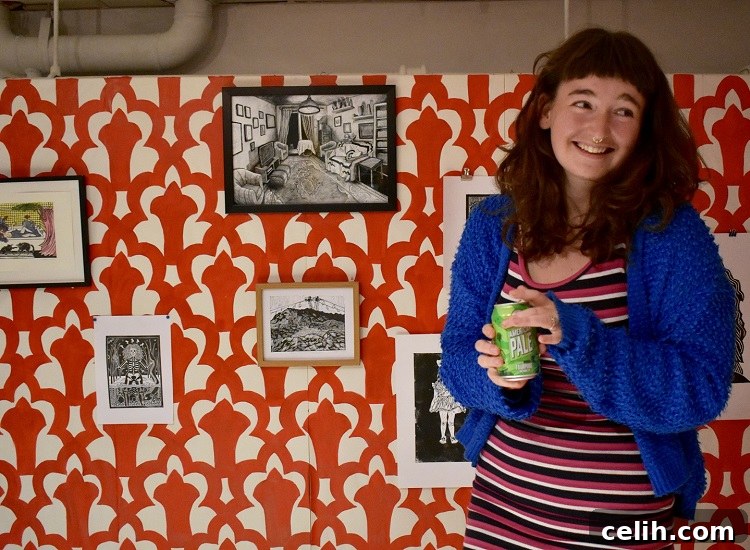
The main image accompanying this article features Debbie Chessell proudly standing in front of her prints and handmade wallpaper, created during her residency with First Floor Space in 2018. All images showcased in this feature are © Debbie Chessell, used with permission.
Feeling inspired by Debbie Chessell’s vibrant artistic journey and her dedication to lino printing? Explore more compelling stories from the world of design and art by catching up on some of our previous interviews:
- No Place Like Home: An Interview with Brooke Copp-Barton of Home Interior Design
- King of Design: An Interview with Carole King of Dear Designer’s Blog
- Off the Wall: An Interview with Olga Shevchenko of Olenka Design