
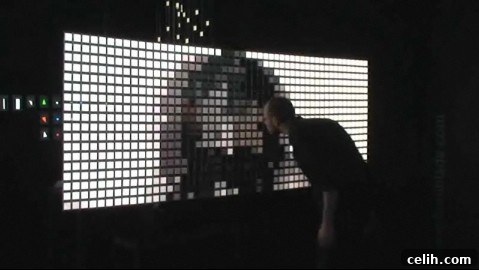
Philips’ Visionary OLED Wall: Redefining Interactive Environments
In an era where technology is increasingly interwoven with our daily lives, companies like Philips are at the forefront of imagining and creating future environments. One such groundbreaking concept that continues to captivate the imagination is Philips’ innovative OLED wall. Far from being a static display, this visionary creation transcends the traditional notion of a wall, transforming it into a dynamic, responsive surface that actively engages with its surroundings and the people within them. It represents a significant leap towards truly ambient intelligence, where our physical spaces are not merely backdrops but active participants in our experiences.
The Dawn of Dynamic Architecture: What is the Philips OLED Wall?
At its core, the Philips OLED wall is envisioned as a seamless, interactive surface composed entirely of advanced OLED (Organic Light Emitting Diode) cells. Unlike conventional displays that are rigid and confined to specific dimensions, OLED technology offers unprecedented flexibility, thinness, and self-emissive properties. This means each pixel generates its own light, allowing for perfect blacks, infinite contrast ratios, vibrant colors, and remarkably wide viewing angles. These intrinsic qualities of OLED make it the ideal medium for creating large-scale, shape-shifting displays that can truly integrate with architectural elements.
The genius of Philips’ concept lies in its ability to perceive and adapt. The wall is designed with sophisticated sensory capabilities that allow it to recognize people as they approach. This isn’t just a simple motion sensor; it implies a deeper level of interaction, potentially leveraging advanced computer vision, depth-sensing technologies, or even AI algorithms to understand human presence and proximity. Upon detection, the wall doesn’t just display a pre-programmed image; it dynamically alters its visual content and, conceptually, even its physical configuration to present a mirror image of the individual standing before it. This level of personalized, real-time reflection turns a passive surface into an active, almost sentient entity, capable of engaging users in a truly immersive manner.
Beyond Reflection: The Transformative Potential of Interactive OLED Surfaces
While the initial concept focused on a mirror-like interaction, the implications of such a technology extend far beyond a mere reflection. Imagine walking into a room where the walls aren’t just decorative but responsive.
1. Smart Homes of Tomorrow:
- Dynamic Ambiance: Walls could adapt to your mood, displaying calming patterns, vibrant artwork, or even virtual windows opening to serene landscapes.
- Information Hubs: Receive personalized news feeds, weather updates, or family messages integrated seamlessly into your environment.
- Interactive Entertainment: Transform your living room into an immersive gaming arena or a breathtaking cinematic experience, with visuals extending beyond the traditional screen.
- Adaptive Decor: Change your home’s interior design on a whim, instantly altering colors, textures, and even the perceived architectural lines of a room.
2. Revolutionizing Retail and Commercial Spaces:
- Engaging Storefronts: Attract customers with dynamic, personalized advertising that reacts to passersby, showcasing products relevant to their demographic or interests.
- Interactive Showrooms: Allow customers to virtually try on clothes, customize products, or explore detailed features on a wall-sized interactive display.
- Corporate Lobbies: Create impressive, futuristic entrances that greet visitors with personalized messages, company information, or interactive brand experiences.
- Dynamic Workplaces: Meeting rooms could feature reconfigurable interactive whiteboards, while office walls could display collaborative dashboards or serve as privacy screens.
3. Enhancing Public and Cultural Spaces:
- Museums and Galleries: Create immersive exhibits where visitors interact directly with historical artifacts or artistic creations on a grand, dynamic scale.
- Transportation Hubs: Provide real-time, interactive wayfinding, flight information, or local attractions, adapting content based on traveler profiles or queries.
- Public Art Installations: Develop monumental, ever-changing digital art that responds to environmental factors or public interaction, transforming urban landscapes.
The Technological Horizon: Challenges and Innovation
Bringing a concept as ambitious as the Philips OLED wall to widespread reality involves surmounting significant technological hurdles, especially considering its original unveiling around 2009.
- Flexible and Scalable OLED Manufacturing: Producing OLED panels large enough and flexible enough to cover entire walls, while maintaining seamless image quality and durability, is a major engineering feat. The ability to create individual, modular OLED cells that can be arranged and rearranged, potentially even changing physical shape, requires breakthroughs in material science and production techniques.
- Advanced Sensor Integration: For the wall to “recognize” and “mirror” individuals, sophisticated sensor arrays are necessary. This includes high-resolution cameras, depth sensors (like LiDAR or Time-of-Flight sensors), and potentially even biometric sensors, all integrated discreetly into the display without disrupting its visual integrity. These sensors must operate in real-time, accurately tracking individuals and their movements.
- Real-time AI and Computational Power: Processing the vast amount of data from sensors, interpreting human presence and intent, and rendering complex, dynamic visual content in real-time demands immense computational power. Artificial intelligence and machine learning algorithms are crucial for intelligent interaction, allowing the wall to anticipate needs or respond intuitively.
- Energy Efficiency: Large-scale interactive displays require substantial power. Innovations in energy-efficient OLED technology and smart power management systems are essential for these walls to be sustainable and practical for widespread use.
- Data Privacy and Security: With systems capable of recognizing and mirroring individuals, questions of data privacy become paramount. Robust security protocols and transparent policies for data collection and usage would be critical for public acceptance and ethical deployment.
Despite these challenges, the rapid pace of technological advancement, particularly in areas like flexible electronics, AI, and sensor miniaturization, makes the realization of such concepts increasingly plausible.
Philips’ Legacy in Innovation
Philips, a company with a rich history of innovation spanning over a century, particularly in lighting, consumer electronics, and healthcare, is uniquely positioned to drive such visionary projects. Their commitment to research and development has consistently pushed the boundaries of what’s possible, from the invention of the compact fluorescent lamp to pioneering advancements in medical imaging. The OLED wall concept fits perfectly within Philips’ long-term vision of creating meaningful innovation that improves people’s lives and shapes the future of connected living and working spaces. It underscores their role not just as a product manufacturer, but as a thought leader in integrating technology seamlessly into our environments.
The Broader Landscape of Ambient Intelligence
The Philips OLED wall is not an isolated concept but rather a striking manifestation of a broader technological trend: ambient intelligence. This refers to electronic environments that are sensitive and responsive to the presence of people. Such environments are characterized by ubiquitous computing, embedded devices, and seamless user interfaces, where technology recedes into the background, empowering users without being intrusive. The OLED wall, with its ability to transform and interact, exemplifies this vision, suggesting a future where our surroundings are not static but dynamic, personalized, and intuitively responsive. It blurs the lines between physical architecture and digital content, suggesting a world where spaces themselves can communicate, inform, and entertain in unprecedented ways.
Conclusion: A Glimpse into a Living Future
Philips’ OLED wall concept offers a compelling glimpse into a future where our environments are as dynamic and responsive as our digital devices. By transforming a simple wall into an interactive, shape-shifting OLED canvas, Philips demonstrates the incredible potential of advanced display technology to redefine human-environment interaction. This visionary project not only highlights the boundless possibilities of OLED but also points towards an exciting future where our living and working spaces are no longer passive backdrops but active, intelligent participants in our daily lives. It’s a testament to the power of innovation to create not just smarter devices, but truly living, adaptive spaces. The journey from concept to widespread reality is long, but the blueprint for a truly integrated and interactive world is clearly laid out. Find out more about its initial video debut and conceptualization here.
Via Engadget.com