
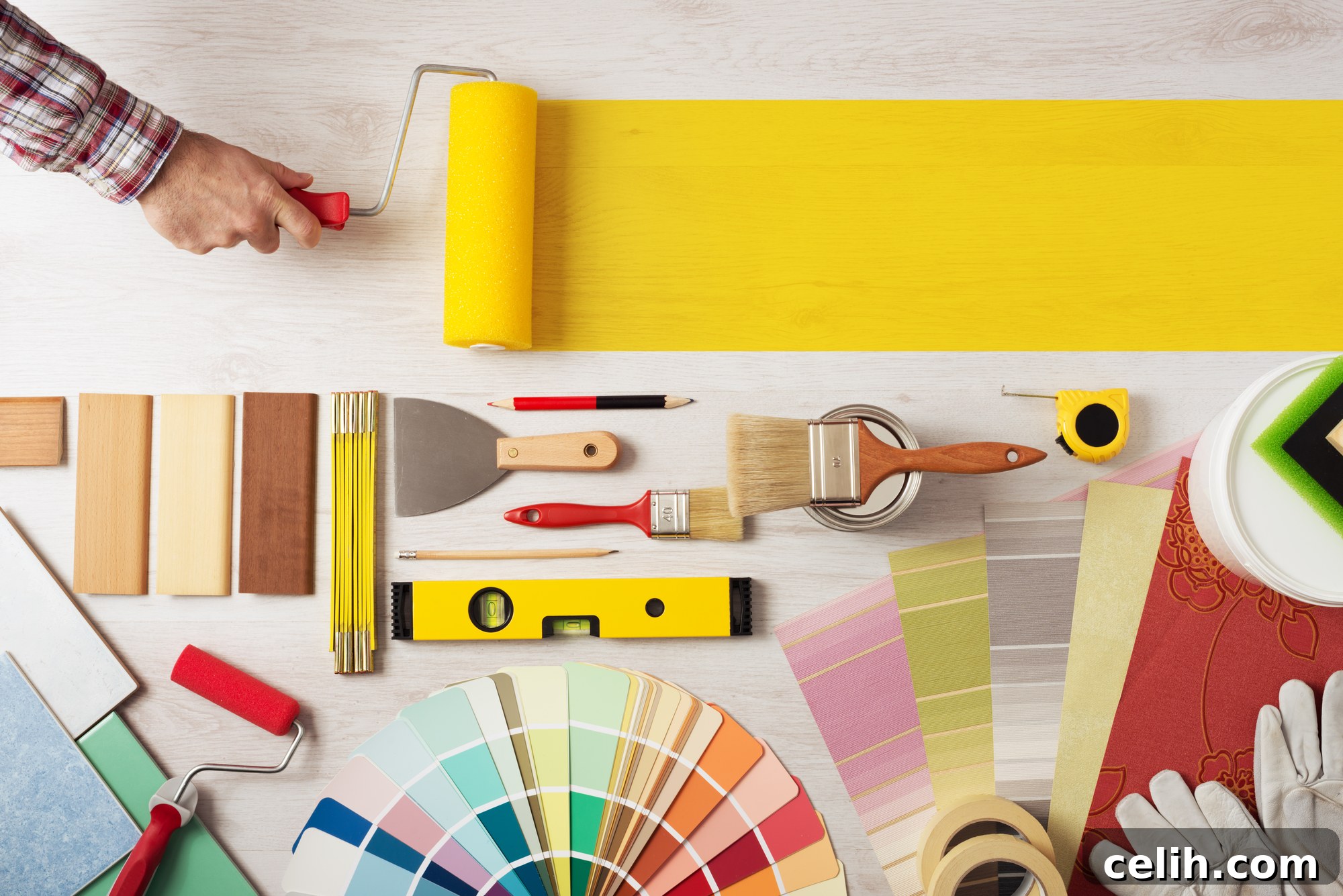
Embarking on a home renovation journey is an incredibly exciting prospect. Whether you’re breathing new life into a charming old property or meticulously customizing a brand-new space to perfectly reflect your personal style, the foundation of a successful project lies in meticulous planning and, crucially, having the right tools at your disposal. A well-equipped toolkit not only streamlines the entire renovation process but also empowers you to tackle tasks with confidence, precision, and efficiency, ultimately ensuring a high-quality finish and a safer working environment. This comprehensive guide will walk you through the essential tools you’ll need to transform your home improvement dreams into a tangible reality, making your renovation efforts as smooth and rewarding as possible.
1. The Indispensable Basic Hand Tools
Every successful home renovation starts with a solid collection of basic hand tools. These are the versatile workhorses that form the backbone of your toolkit, proving invaluable for countless tasks from simple repairs to complex installations. Investing in good quality hand tools will serve you well for years to come.
- Hammer: An absolute essential, a good quality claw hammer is used for driving nails, prying boards, and demolition work. Consider a lighter framing hammer for general tasks and perhaps a heavier sledgehammer for more significant demolition if your project demands it. The balance and grip of a hammer can significantly impact your efficiency and reduce fatigue.
- Screwdrivers: A comprehensive set of screwdrivers is non-negotiable. You’ll need both flat-head (slot) and Phillips-head types in various sizes. For modern fixtures and furniture, consider expanding your collection to include Torx, Robertson (square), and Allen (hex) keys. A multi-bit screwdriver can be a space-saving alternative, offering a range of bits in one convenient handle.
- Tape Measure: Precision is paramount in home improvement. A reliable and sturdy tape measure, preferably one with a locking mechanism and a wide, rigid blade that extends far without bending, is critical for accurate measurements. Always remember the adage: “measure twice, cut once.” Magnetic tips can also be incredibly useful for solo measuring on metallic surfaces.
- Utility Knife: A sharp utility knife, often referred to as a box cutter, is incredibly versatile. It’s perfect for cutting various materials such as drywall, insulation, wallpaper, cardboard, and even some types of flooring. Always use a fresh, sharp blade for safety and efficiency, and ensure it has a robust locking mechanism to prevent accidental retraction or extension.
- Pliers: A set of pliers is indispensable for gripping, bending, and cutting wires, small objects, and even for stubborn bolts. Common types include slip-joint pliers for general use, needle-nose pliers for delicate work in tight spaces, and channel-lock pliers for a strong grip on pipes and larger items.
- Adjustable Wrench (Spanner): For tightening and loosening nuts and bolts of various sizes, an adjustable wrench offers excellent versatility without needing an entire set of fixed wrenches. Ensure it has minimal jaw play for a secure grip and to prevent rounding off fasteners.
- Sack Trucks (Hand Trucks): When dealing with heavy materials like appliances, bags of cement, or large boxes of tiles, a sack truck can be a lifesaver. This simple yet effective tool significantly reduces physical strain, prevents injuries, and makes moving cumbersome items around your renovation site much easier. Various types exist, including stair-climbing models and platform trucks, so choose one suited to the specific demands of your project.
2. Unleashing Efficiency with Power Tools
Power tools are designed to amplify your efforts, making difficult tasks far easier, faster, and often more precise. While they require careful handling and adherence to safety protocols, they are essential for any significant renovation project.
- Electric Drill/Impact Driver: A high-quality cordless drill is perhaps the most fundamental power tool. It’s essential for drilling holes into wood, metal, drywall, and masonry (with a hammer drill function) and for driving screws efficiently. Look for models with variable speeds, multiple clutch settings, and a good battery life. An impact driver, while similar, excels at driving long screws and bolts with less effort, making it a powerful complement to a standard drill.
- Circular Saw: For making straight, fast, and accurate cuts in large pieces of wood, plywood, or OSB, a circular saw is invaluable. It’s significantly quicker and more efficient than any hand saw. Familiarize yourself with proper blade selection (different teeth counts for different materials and finishes) and always use appropriate safety guards and eye protection.
- Jigsaw: When your project calls for intricate cuts, curves, or cut-outs in various materials like wood, plastic, or even thin metal, a jigsaw is your go-to tool. Its oscillating blade allows for detailed work that a circular saw cannot achieve. Different blade types are available for different materials and cutting speeds.
- Electric Sander: Manual sanding is incredibly time-consuming and labor-intensive. An electric sander, whether an orbital sander for general smoothing, a belt sander for aggressive material removal, or a detail sander for tight corners, speeds up the process dramatically and ensures a consistently smooth finish ready for painting or staining. Look for models with dust collection systems to keep your workspace cleaner.
- Reciprocating Saw (Sawzall): Often referred to as a “demolition saw,” a reciprocating saw is excellent for rough cuts, cutting through pipes, studs, and other materials during demolition phases. Its robust blade and powerful action make it ideal for quick, aggressive tasks where precision is less critical than raw cutting power.
3. Achieving Perfection with Painting and Decorating Tools
Painting and decorating often represent the final, transformative touches in a renovation. The right tools are crucial for achieving a professional, flawless finish that elevates the entire space.
- Paintbrushes and Rollers: Invest in a variety of high-quality brushes and rollers. You’ll need different sizes and types: angled brushes for cutting in precise edges, smaller brushes for trim, and larger rollers for walls and ceilings. Choose roller naps (the fabric thickness) appropriate for your surface – short naps for smooth surfaces, longer naps for textured ones. Quality brushes and rollers hold more paint, reduce drips, and leave fewer streaks.
- Painter’s Tape: This essential tape is used to mask off areas you want to protect from paint, such as trim, window frames, and electrical outlets. Good quality painter’s tape creates clean, sharp lines and peels off easily without damaging the underlying surface. Different adhesion levels are available for various surfaces and durations.
- Drop Cloths: Protect your valuable floors, furniture, and any other surfaces from inevitable paint spills and splatters with durable drop cloths. Canvas drop cloths are reusable, absorb spills, and provide better traction than plastic sheets, though plastic is often cheaper for single-use applications. Covering everything thoroughly is key to a clean renovation.
- Paint Trays and Liners: A sturdy paint tray is essential for holding paint for rollers. Using disposable plastic liners simplifies cleanup immensely, allowing you to switch colors easily or simply discard the liner when finished.
- Spackling Knives/Putty Knives: Before painting, walls often need preparation. Spackling knives are perfect for applying spackle or joint compound to fill holes, cracks, and imperfections, ensuring a smooth surface. They can also be used for scraping off old paint or wallpaper.
4. Precision and Accuracy with Measuring and Levelling Tools
In renovation, precision isn’t just a nicety; it’s a necessity. Accurate measurements and perfectly level installations are what separate amateur work from a professional finish.
- Spirit Level: A fundamental tool for ensuring that shelves, pictures, cabinets, and other installations are perfectly horizontal or vertical. Spirit levels come in various lengths; having a few different sizes (e.g., a small torpedo level, a 2-foot, and a 4-foot level) provides versatility for different tasks.
- Laser Level: For larger projects, a laser level can significantly increase both speed and accuracy. It projects a perfectly level or plumb line (or cross-lines) across your work surface, making it ideal for tiling, installing cabinets, hanging picture galleries, or establishing a consistent trim line around a room. Self-leveling features are a huge time-saver.
- Stud Finder: Before drilling or hanging anything heavy on a wall, a stud finder is indispensable. It helps you locate the wooden or metal studs behind drywall, ensuring you mount items securely. Modern electronic stud finders can also detect live electrical wires and pipes, adding a crucial layer of safety to your work.
- Chalk Line: For marking long, straight lines across floors, walls, or ceilings – such as for laying tile or painting a crisp border – a chalk line is far more efficient and accurate than trying to draw a line freehand or with a straightedge.
5. Prioritizing Your Well-being with Safety Gear
Safety should never be an afterthought in any home renovation project. Protecting yourself from potential hazards is paramount. Always assess the risks of each task and equip yourself accordingly.
- Safety Glasses/Goggles: Your eyes are incredibly vulnerable to flying debris, dust, chemical splashes, and bright lights from power tools. A good pair of ANSI-rated safety glasses or goggles is non-negotiable for virtually every task, from drilling to demolition.
- Work Gloves: Protect your hands from cuts, scrapes, splinters, punctures, and exposure to chemicals. Different types of gloves offer varying levels of protection; heavy-duty leather gloves for demolition, cut-resistant gloves for sharp objects, and nitrile or latex gloves for chemical handling.
- Dust Masks/Respirators: Renovation projects invariably generate a significant amount of dust, which can contain harmful particles (e.g., wood dust, drywall dust, old paint particles). A good quality dust mask (N95 respirator is recommended for fine particulates) helps filter out these airborne irritants, protecting your respiratory system.
- Hearing Protection: Power tools, especially saws and drills, can produce noise levels that can permanently damage your hearing. Invest in comfortable earplugs or earmuffs and use them whenever operating noisy equipment.
- First-Aid Kit: Accidents, even minor ones, can happen. Keep a well-stocked first-aid kit readily accessible in your workspace, complete with bandages, antiseptic wipes, pain relievers, and any personal medications you might need.
6. Essential Miscellaneous and Specialty Tools
Beyond the core categories, a few other tools can significantly enhance your renovation capabilities and convenience.
- Pry Bar / Crowbar: For effective demolition, removing old trim, pulling up flooring, or separating stubborn components, a sturdy pry bar or crowbar is indispensable. Its leverage makes quick work of tasks that would be impossible by hand.
- Shop Vacuum (Wet/Dry Vac): Renovations create a mess. A powerful shop vacuum is far more capable than a household vacuum for cleaning up large debris, sawdust, plaster dust, and even liquids. It’s essential for maintaining a clean and safe workspace throughout your project.
- Caulk Gun: For sealing gaps and cracks around windows, doors, bathtubs, sinks, and trim, a caulk gun is a must-have. It allows for precise application of caulk or sealant, improving aesthetics and energy efficiency.
- Toolbox or Storage System: While not a tool itself, effective organization is key to efficiency. A robust toolbox, tool chest, or mobile workstation keeps your tools organized, protected, and easily transportable, saving you time searching for the right implement.
Conclusion: Building Your Renovation Success Story
Embarking on a home renovation, whether big or small, is a fulfilling endeavor that promises to transform your living space. However, it’s a complex undertaking that demands careful planning, a clear vision, and, most importantly, the right arsenal of tools. By thoughtfully investing in high-quality, essential tools – from the fundamental hand tools to advanced power tools and critical safety gear – you’re not just buying equipment; you’re investing in the success, efficiency, and safety of your entire project.
A well-chosen toolkit not only makes the renovation process smoother and more enjoyable but also allows you to achieve a superior standard of workmanship. It empowers you to tackle challenges confidently, knowing you have the right instrument for every task. Prioritizing safety through proper gear is equally paramount, ensuring your well-being throughout the transformation. So, equip yourself wisely, approach each task with care, and get ready to create the home of your dreams. Happy renovating!
Related Posts:
Essential DIY Upcycling Tools for Furniture Projects