
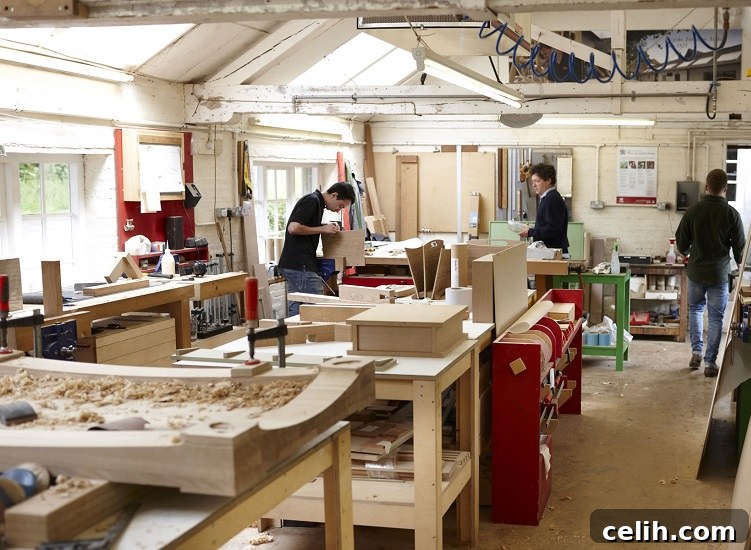
Edward Barnsley Workshop: Crafting Timeless Bespoke Furniture for Over a Century
In the quiet heart of the English countryside, a legacy of exquisite woodworking continues to flourish. James Ryan, the esteemed designer and manager of the Edward Barnsley Workshop, shoulders the profound responsibility of guiding an institution steeped in history. For 26 years, Ryan has dedicated himself to the art of crafting and designing wooden furniture, yet his tenure represents but a fraction of the workshop’s remarkable journey, which spans over four times that duration in continuous operation.
The workshop’s namesake, Edward Barnsley, was born in 1900 into a family already renowned for its furniture-making prowess. Over his illustrious lifetime, Barnsley created more than seven thousand individual pieces, leaving an indelible mark on the British Arts and Crafts movement. His vision and meticulous approach cemented his status as a pivotal figure, influencing generations of woodworkers and designers. The workshop has been entrusted with numerous high-profile commissions throughout its history, including the creation of the robust oak boards for the historic Domesday Book and various significant pieces for the Palace of Westminster, underscoring its unparalleled reputation for quality and craftsmanship.
Edward Barnsley himself was a staunch advocate for the superior quality and unique character that hand tools imparted to each piece of furniture. He believed deeply in the individual touch of his skilled craftsmen, allowing them to imbue every item with a distinctive personality. While upholding these traditional values, Barnsley was also pragmatic, acknowledging the inevitability of progress; in 1955, he introduced electricity to the workshop, a testament to his balanced approach of preserving heritage while embracing necessary innovation.
Today, the Edward Barnsley Workshop continues this cherished tradition. It meticulously produces individual, hand-crafted pieces that resonate with their rich heritage, yet are infused with contemporary twists that appeal to modern sensibilities. To delve deeper into the enduring success and unique philosophy of this iconic institution, Sara Walker recently spoke with James Ryan.
The Enduring Philosophy of Bespoke Excellence
“I firmly believe that the Barnsley Workshop has maintained its success in producing bespoke furniture for nearly a century due to the distinctive and unparalleled approach established by Edward Barnsley himself,” James explains with a sense of pride. This unique methodology, he elaborates, centres around the fundamental principle that only highly skilled makers can create furniture of such exceptional caliber.
From its inception, Edward Barnsley envisioned a workshop where his employees were not merely labourers but true artisans. He encouraged them to fully utilize their expertise and experience, a philosophy that remains profoundly evident in every finished piece. “Customers are consistently drawn to the skilled workmanship and the tangible quality present in our furniture,” James notes. “We pride ourselves on always considering our clients’ personal requirements in meticulous detail throughout the entire design and creation process, ensuring each piece is a perfect reflection of their vision.”
A Personalized Design Journey
Continuing a practice initiated by Edward Barnsley himself, James often undertakes personal visits to potential clients’ homes. These consultations are crucial, allowing him to discuss their needs in depth and assess the available space before embarking on any design. This initial, immersive step ensures that the final design is not only aesthetically pleasing but also perfectly functional and integrated into its intended environment.
“During the design phase, I meticulously consider how the client intends to use the furniture, paying close attention to the piece’s shape, form, and overall aesthetic,” James states. “Simultaneously, I factor in the practical aspects of its construction, ensuring that the design can be executed correctly and to our exacting standards. This holistic approach guarantees that every bespoke commission is both a work of art and a practical addition to a client’s home.” This careful balance of client vision, artistic design, and practical execution is a cornerstone of the workshop’s century-old success in bespoke furniture design.
The Art of Selecting and Preparing Timber
The choice of material is paramount at the Edward Barnsley Workshop, reflecting a deep respect for natural resources and a commitment to sustainability. “We predominantly craft our custom furniture using native hardwoods,” James explains. “These timbers are carefully sourced, cut, and then meticulously dried in our purpose-built seasoning sheds. This process is essential for ensuring the wood’s stability and longevity, which are critical for creating furniture that will last for generations.”
Occasionally, the workshop undertakes truly unique commissions where clients provide timber from their own trees. “This presents both a fascinating challenge and a rewarding experience,” James admits. “Working with client-supplied timber, especially if the tree has natural defects or unusual characteristics, demands exceptional skill and adaptability. However, these projects often yield some of our most extraordinary and emotionally resonant pieces, each telling a personal story.” The workshop’s preferred hardwoods, known for their beauty and durability, include classic choices such as oak, ash, walnut, and cherry, each selected for its unique grain and properties suitable for bespoke furniture.
From Concept to Creation: The Workshop Process
The creation of each piece of Edward Barnsley furniture is a testament to focused dedication. “Typically, one artisan in our workshop is responsible for a single piece from its very inception to its final finish,” James elaborates. “This approach fosters a deep connection between the maker and the furniture, ensuring consistent quality and an artisanal touch. However, for larger commissions, such as the monumental order for 111 chairs for Magdalen College, Oxford, in 2015, our entire team collaborates seamlessly, demonstrating our capacity for collective craftsmanship.”
The Meticulous Steps of Handcrafting
The journey of a bespoke furniture piece begins with a crucial first step: the creation of a full-size working drawing. “The maker undertakes this drawing under my close supervision, translating the scaled design that has been thoroughly agreed upon with the client into a detailed, life-size blueprint,” James explains. This meticulous drawing serves as the foundation for the subsequent stages. Following this, the maker compiles a precise cutting list, which guides the selection and preparation of the raw timber.
Each individual component of the furniture is then carefully marked out on the rough boards of timber and cut slightly oversized. This deliberate allowance is vital. “We then set these oversized components aside in the workshop for as long as possible,” James notes. “This allows the wood to naturally acclimatise to the workshop’s environment, and any inherent wood movement to settle down, preventing future warping or cracking – a critical step for durability.”
When crafting a chair, for instance, the process often commences with the intricate shaping of the back legs. Joints are meticulously cut with precision, followed by the careful gluing of sub-assemblies. The final structural integrity is achieved by skillfully using the side-rails to join the front and back sections of the chair. A significant amount of time and unwavering attention is devoted to the finishing stages. “After the initial glue-up, pieces undergo careful planing and extensive sanding,” James emphasizes. “It is remarkably easy to underestimate the sheer amount of time and precision that goes into this part of the making process, but it is absolutely fundamental to achieving the flawless finish that defines Edward Barnsley furniture.” This commitment to detail ensures every piece is not just functional, but a true work of art.
Nurturing Future Generations: The Edward Barnsley Educational Trust
Deeply committed to the perpetuation of traditional woodworking skills, the Edward Barnsley Workshop plays a vital role in nurturing future generations of artisans. In 1980, the Edward Barnsley Educational Trust (EBET) was established with the specific mission of offering comprehensive apprenticeships. These apprenticeships are designed to transmit the intricate knowledge and meticulous techniques that have defined the workshop’s legacy for over a century. Additionally, EBET occasionally accommodates fee-paying pupils, providing wider access to this invaluable training.
Encouraging Diversity in Craftsmanship
When questioned about the apparent gender imbalance among current apprentices, James reflects on the issue with thoughtful candour. “There are absolutely no physical barriers that would prevent women from excelling in this craft,” he states firmly. “I’m genuinely unsure why we don’t receive a higher volume of apprenticeship applications from women, but it’s something I sincerely hope will change in the coming years.”
James believes that a broader societal shift is needed to encourage more women into furniture-making. “To see more women become skilled furniture-makers, we simply need to challenge some traditionally accepted ideas about roles in skilled trades. While attitudes are gradually evolving, it naturally takes time,” he explains. He proudly highlights recent progress: “In recent years, the Edward Barnsley Educational Trust has successfully engaged two talented women as apprentices. The most recent was Laura, who joined us six years ago and has flourished here. Importantly, the proportion of male to female apprentices mirrors the proportion of applicants we receive, underscoring the need to encourage more women to apply in the first place.” James reiterates his desire to see a greater number of women embarking on this rewarding career path, enriching the craft with diverse perspectives and talents.
The Journey to Master Craftsmanship
Developing true mastery in furniture making is a demanding yet rewarding endeavor. “I generally estimate that it takes approximately five years for an apprentice to evolve into a fully skilled craftsman, capable of creating virtually any piece of furniture with confidence and precision,” James notes. “Of course, exceptionally talented individuals may reach that level of proficiency a little sooner, but consistency comes with dedication.”
The workshop’s apprentices typically arrive with two to three years of foundational experience, usually acquired at further education colleges. “After just a few weeks of intensive training with us, they are able to execute the basic woodworking tasks to a very high standard,” James explains. “However, it then takes many months, and indeed years, to truly learn how to create a wide and diverse range of pieces, and crucially, to achieve consistent high-quality work efficiently. Our aim is to equip our apprentices with the skills to craft a piece of furniture using both traditional hand tools and modern, high-tech methods. We want them to be equally skillful and adaptable, whether they are using the simplest hand plane or the most advanced machinery. The ultimate goal, irrespective of the tools employed, is always the same: a final product of unparalleled quality and beauty.” This comprehensive training ensures the enduring excellence of Edward Barnsley furniture.
Harmony of Heritage and Modernity in Bespoke Furniture
With such an impressive lineage and a rich history behind him, James Ryan is acutely aware of the delicate balance required to combine the company’s cherished heritage and deeply ingrained traditions with the demands of being a successful modern business. “It’s a continuous process of evaluating what makes our service and our work truly unique and individual, and understanding the core reasons behind what we do,” he replies thoughtfully, when asked about this intricate balance.
“I also believe that this clarity of thinking greatly assists with both training our apprentices and promoting our bespoke furniture effectively,” James adds. “In terms of guiding the company into the future, my overarching aim is to perpetually improve, innovate, and adapt. Our work must inherently evolve because we create for discerning clients whose lifestyles are constantly changing over time. For example, I was recently commissioned to design a bespoke sitting and standing desk for a client’s home office. This specific design brief perfectly reflects the dynamic ways we live and work now, even in 2018 when the request was made. It’s a testament to how traditional craftsmanship can seamlessly integrate with contemporary needs, ensuring that the Edward Barnsley Workshop remains at the forefront of luxury bespoke furniture design for centuries to come.”
To discover more about the exceptional Edward Barnsley furniture, to inquire about commissioning a unique piece, or to view the exquisite range of items currently in stock, please visit www.barnsley-furniture.co.uk. Prices for beautifully crafted home accessories start from £65.
All images (c) Edward Barnsley Workshop. All rights reserved.